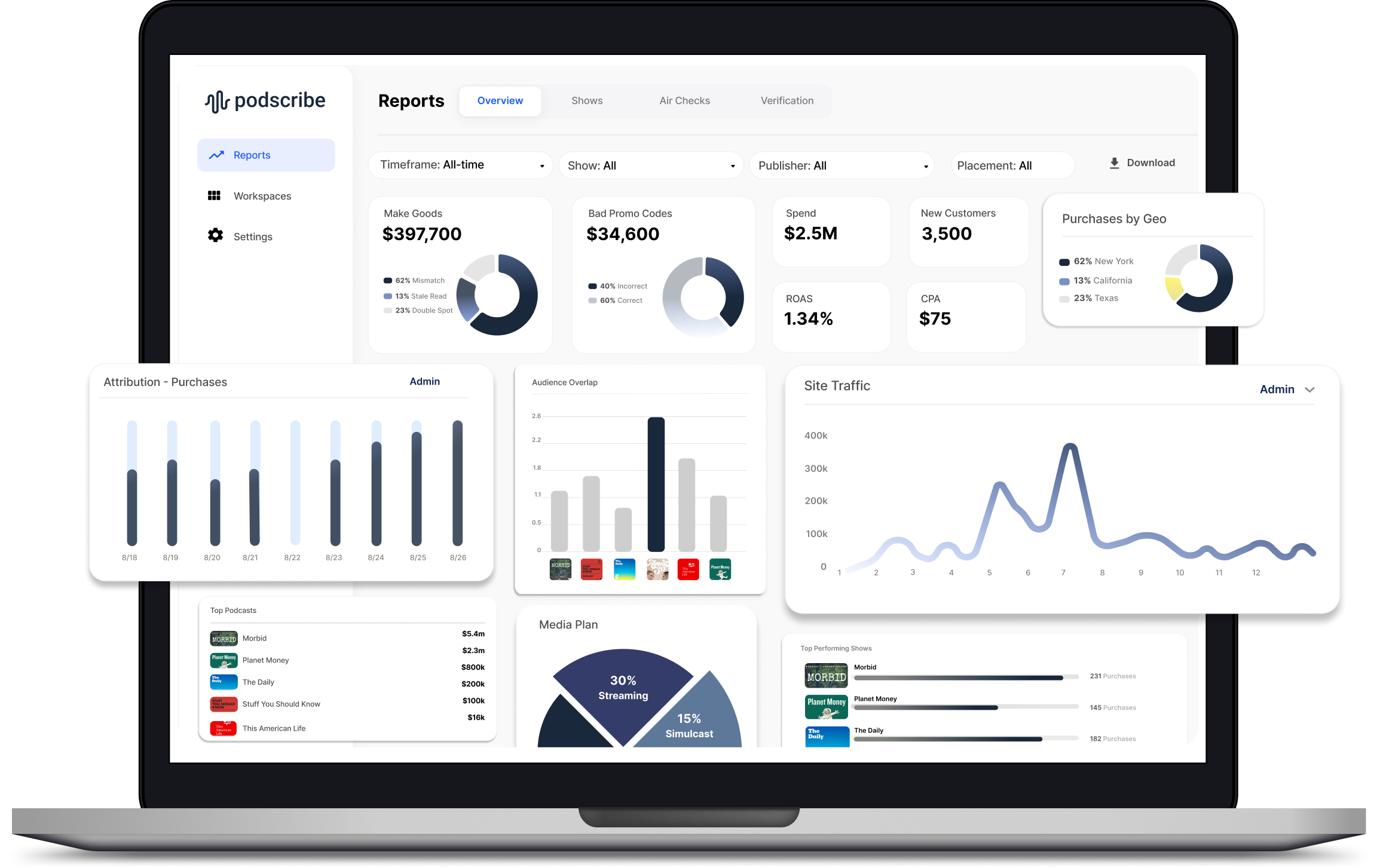


Radio Aircheck Solutions That Prove Your Spots Ran
Spot logs aren’t proof. Podscribe’s automated radio airchecks confirm when your ads aired, where they ran, and what creative played, in the dashboard you already use.

Trusted by the Largest Brands, Agencies, and Publishers
























Nielsen tells radio buyers to measure on as-run data, not planned GRPs — because “actual delivery often deviates from planned delivery.”
Source: Nielsen, Audio Today 2026: How America Listens, March 2026.
Radio delivers reach at a scale few channels match. What it has never delivered is proof. Advertisers have spent decades accepting station paperwork as evidence that a campaign ran the way it was bought, while holding every other channel — including the podcast buys already covered by podcast ad verification — to a far higher standard. The gap isn’t in radio’s performance. It’s in what you can independently confirm about it, which is exactly the job a radio aircheck does.
Are Unverified Radio Spots Costing You More Than You Think?

Most Common Issues
Manual Checks Don’t Scale

Spot-checking works for one station. Across dozens of markets and dayparts, it becomes sampling, not verification.
No Record, No Make-Good Leverage
Without timestamped evidence, a missed spot becomes a negotiation about recollection, and you absorb the loss.
Radio Reporting Lives in a Silo
Radio delivery arrives separately from podcast and social, making every campaign wrap-up a manual reconciliation.
Station Logs Aren’t Independent Proof
Affidavits confirm what was scheduled, not what aired — from the same partner selling you the inventory.
What Podscribe’s Radio Airchecks Deliver
Radio has always delivered reach. With airchecks, it delivers clarity — the same verification standard you already apply to podcasts, extended to every station in your buy, whether that buy is a single-market test or a full national campaign.

Pay Only for Spots That Ran
Discrepancies surface in your reporting, so you approve invoices against an independent record.
Settle Disputes with Timestamped Proof
Station, timestamp, and transcript in one place. Send it once and the question is closed.
One Dashboard for Every Audio Channel
Radio, podcast, and social delivery in a single view instead of three separate reports.
Scale Verification Across Markets
Coverage grows with the buy, not with your team’s listening hours.
What Podscribe Radio Airchecks Cover
-
![]()
Automated Spot Detection
Podscribe automatically detects and logs every radio spot in your campaign, so the record builds itself as the campaign runs.
-
![]()
Station, Daypart, and Timing Confirmation
Airchecks confirm when and where each spot ran, with delivery broken out by station, publisher, DMA, and daypart.
-
![Transcripts]()
Creative Confirmation
Verification confirms which creative aired, catching wrong versions, wrong offers, and early cuts that a station log would never surface.
-
![]()
Audio and Transcripts You Can Share
Every aircheck pairs the captured spot with an automated transcript, so clips go straight to clients or publishers without chasing a recording.
-
![]()
Unified Cross-Channel View
Radio sits alongside podcast and social aircheck data in one dashboard, so the full campaign footprint reads as a single report.
-
![]()
The Same Verification Flags as Podcast
All of Podscribe’s standard placement verification flags apply to radio, so there is no second methodology to learn or explain to a client.


Radio verification is only worth as much as the party doing the verifying. Podscribe sits independently between your campaigns and your reporting, alongside the audio attribution and measurement you already run.
Why Advertisers Choose Podscribe for Radio Ad Verification

Independent by Design
Podscribe doesn’t sell radio inventory, so the delivery data has no stake in the outcome.
IAB-Certified Measurement Standards
Independent, standards-based measurement, so radio reporting withstands the scrutiny digital already does.
No New Platform or Login
Airchecks run inside the Podscribe dashboard your team already uses.
Simple Activation
One conversation to enable, and airchecks work as a standalone first step before full measurement.
The Marketing Intelligence Engine for Audio Advertising
A one-stop solution to help advertisers, agencies, and publishers measure, improve, and scale performance at every stage in the funnel.


Frequently Asked Questions
What is a radio aircheck?
How is a radio aircheck different from a station affidavit or post log?
How does Podscribe verify radio ad delivery?
Does Podscribe support both AM/FM and satellite radio?
Do I need a separate platform or login to use radio airchecks?
Can I share radio aircheck proof with publishers and clients?
How soon after a spot airs does it appear as an aircheck?
How do I enable radio airchecks for my campaigns?
Every Spot Booked Should Be a Spot Verified
Radio doesn’t have to be the channel you take on faith. Bring it up to the standard you already hold the rest of your audio spend to, and see delivery and performance for every channel in the same place. Airchecks are the fastest way to start — no new platform, and proof on your next flight.
Request a demo by completing the form below: